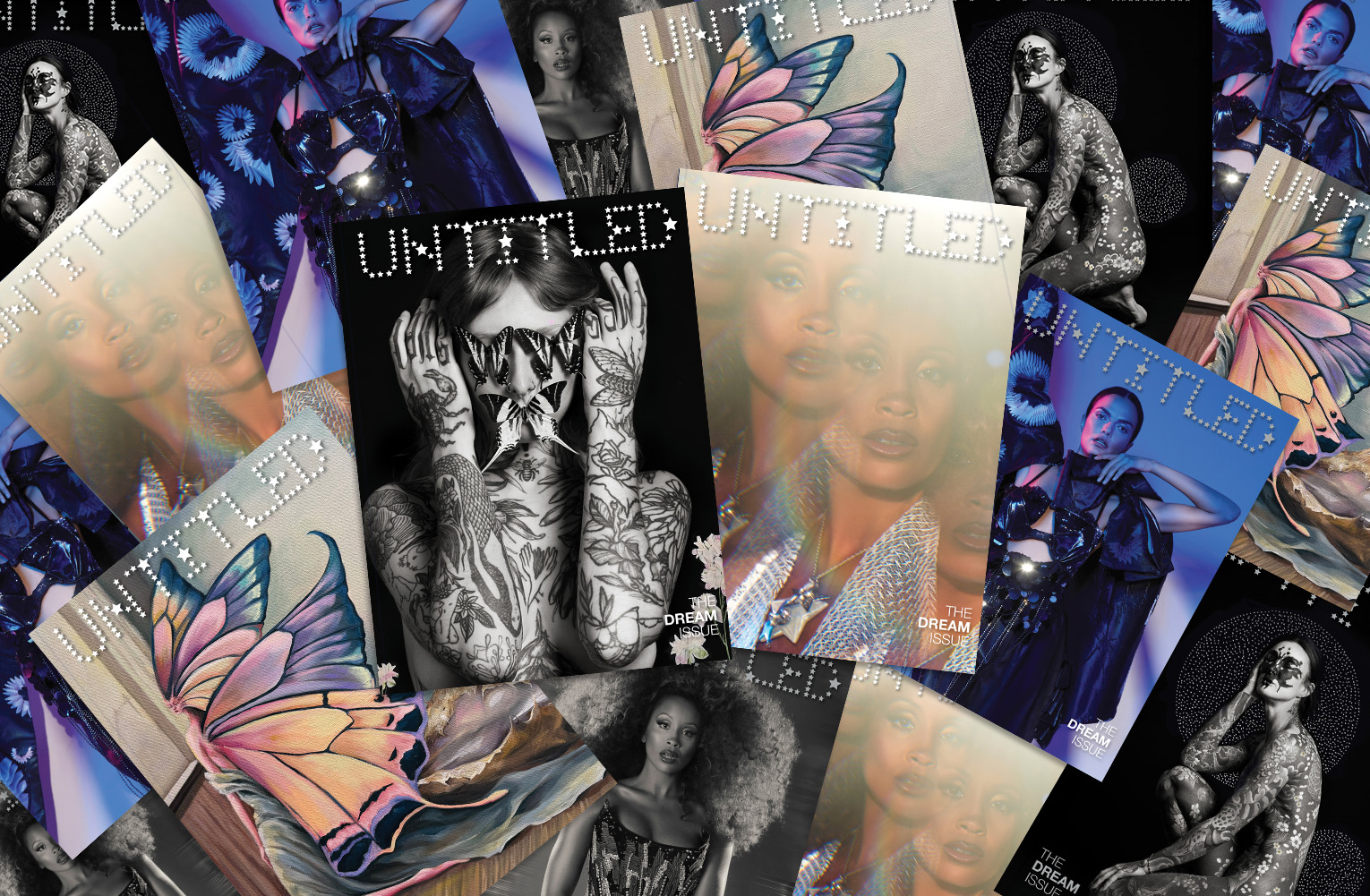
DREAM ISSUE EXCLUSIVE: ARTIST CAROLINA PAVIA CROSSING THE VEIL OF DREAMS
Mexican painter Carolina Pavia constructs psychological worlds in which women cross thresholds, emerge from cocoons, and merge with flowers, insects, and animals. Rooted in surrealism, mythology, psychoanalysis, and emotional memory, her paintings give visible form to experiences that resist ordinary language. “From a very young age, I understood that an image could contain something that words could not always explain,” she recalls.
Born in Morelia, Michoacán, Pavia grew up surrounded by artists and began her career in urban art in 2008, when she was fifteen. The scale and public immediacy of muralism taught her to understand an image as an environment capable of transforming both a place and its viewer. She later refined her figurative technique at the Academia de Artes de Verbuac, developing the command of anatomy, structure, and light that now makes her imagined beings feel uncannily present. Her practice brings this academic foundation together with the freedom of street art, creating spaces where physical reality yields to subconscious logic.
Pavia’s work has been presented at Museo Franz Mayer, Museo Soumaya, Museo de la Mujer, Palacio Clavijero, Museo UPAEP, and in “El Canto de la Catrina” in Rome. Her 2025 solo exhibition, “Adentro, Inhabiting the Invisible,” at Palacio Clavijero explored unseen inner territories as spaces one might enter.
Across her paintings, hybrid figures inhabit suspended narratives. Doors become thresholds, shadows carry suppressed feeling, and organic forms embody transformation. Pavia spoke with The Untitled Magazine about her practice, subconscious logic, and her ambition to create worlds beyond the canvas.
You grew up in Morelia, Mexico, in a family of artists. What are your earliest memories of making art, and when did you begin to see it as your life’s path?
My earliest memories related to art are not necessarily tied to a particular artwork, but rather to the feeling that creating was a natural way of inhabiting the world. Drawing and painting gradually became a way of observing, imagining, and understanding what I felt. Over time, I discovered that I did not simply want to create beautiful images. I wanted to build worlds, ask questions, and discover what exists beneath the surface. It was then that art began to evolve from an inclination into a calling.
You entered the world of street art and muralism when you were only fifteen. What drew you to it at such a young age?
I was drawn to the possibility of taking art out of traditional spaces and bringing it into the street. Muralism had a sense of freedom and confrontation. A work could exist in front of people, transform an everyday environment, and become part of a community’s lived experience.
I was also fascinated by scale. Painting something much larger than myself was an almost physical experience. There was something incredibly powerful about standing in front of a blank wall and realizing that I could transform it into another place. I think that was where my relationship with painting as a way of constructing worlds truly began.
How did working on murals and at such a large scale shape the painter you ultimately became?
Muralism taught me to think on a large scale, not only in terms of dimensions, but in terms of possibilities. I learned to understand space, movement, composition, and the way an image can relate to the viewer’s body. It also taught me something that remains central to my practice: a painting has the power to transform the perception of a place. Even when I work on a canvas, I often feel that I am creating a space that the viewer can enter.
You later studied figurative painting at the Academia de Artes de Verbuac. How did that academic training transform your approach to painting?
Studying figurative painting at the Academia de Artes de Verbuac marked an important shift in my practice. Academic training gave me a deeper understanding of the body, anatomy, structure, light, and technique.
But, paradoxically, learning the rules also taught me when I needed to break them. Technical training did not replace my imaginary world; it gave me the tools to construct it with greater precision. From that point on, I was able to make the impossible feel believable within the language of painting.
Your work brings together themes of surrealism, mythology, psychoanalysis, and personal experience. How do those influences converge when you begin a new piece?
I do not always start with a fully defined story. Sometimes I begin with a sensation, an image, a question, or an association. Surrealism allows me to enter the territory of the impossible. Mythology connects me with symbols that belong to a collective memory, while psychoanalysis interests me because it opens a door toward what we cannot always explain consciously. My personal experience runs through all of this, although not necessarily in a literal way.
Painting becomes a space where all these layers can coexist. I am not trying to illustrate a theory; I am trying to discover what emerges when these ideas begin to speak to one another.
Women in your paintings often merge with flowers, insects, and other elements of nature. What draws you to creating these hybrid figures?
I am deeply interested in the idea that the human body is not separate from nature, even though our culture has often taught us to think of it that way. The transformation of these figures represents an expansion of identity for me. They are not women becoming nature as a loss of their humanity; rather, they are women revealing another dimension of themselves. Metamorphosis allows me to speak about vulnerability, strength, desire, growth, and our relationship with the things we cannot control.
Your paintings are filled with recurring symbols, including flowers, doors, shadows, animals, and metamorphosing bodies. Do these symbols have a consistent meaning for you, or does their significance change from one work to another?
There are certain symbols that return because they still have something to tell me. Doors, for example, appear as thresholds. Shadows can represent what remains hidden. Animals often function as extensions of instincts or emotions, while flowers can speak of beauty, transformation, and fragility.
But I do not believe there is a fixed dictionary for my work. The meaning of a symbol can change from one painting to another and depending on the moment in my life in which it appears.
I am interested in that ambiguity. A symbol can hold a very personal meaning for me while simultaneously awakening something completely different in the person looking at the work.
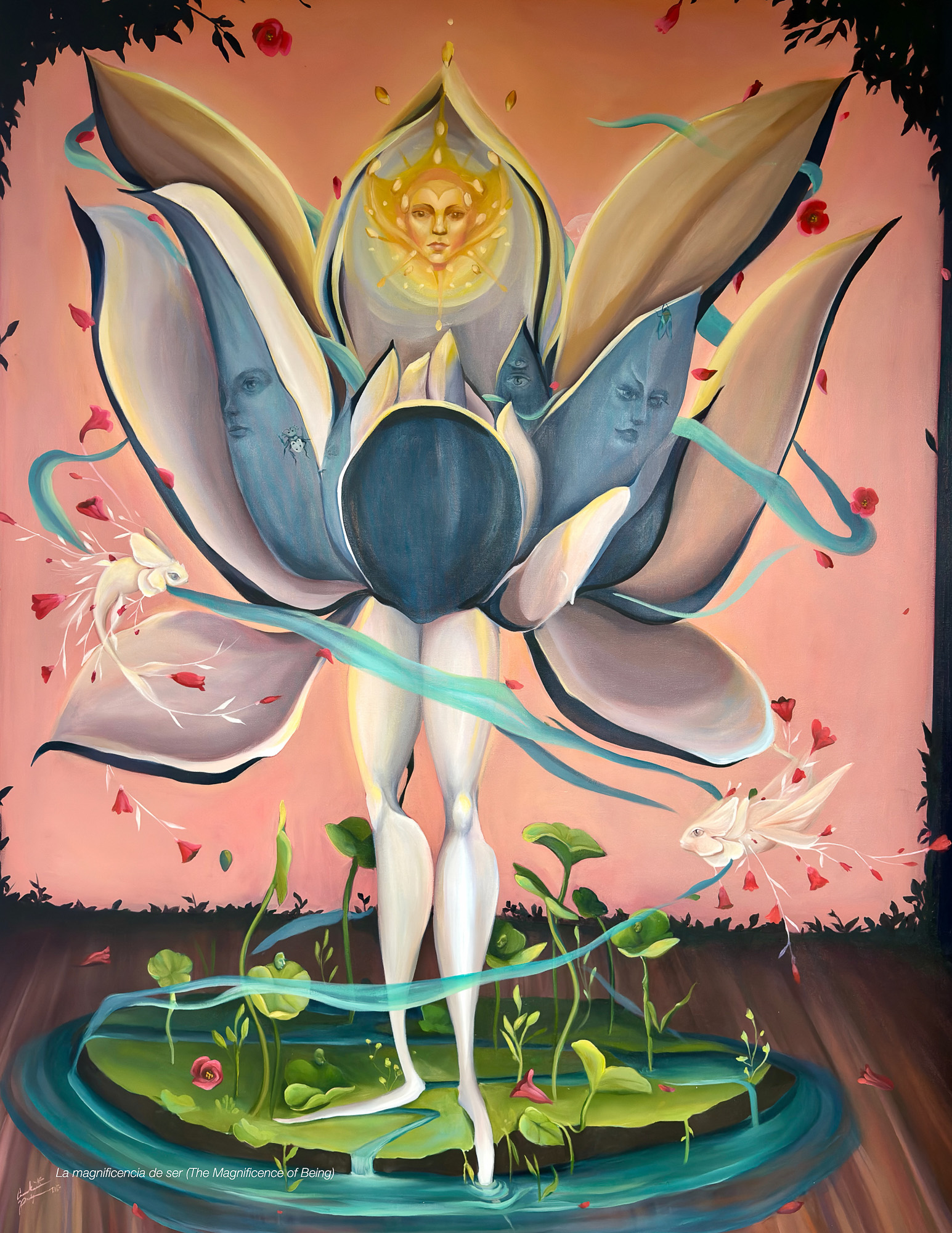
“The Magnificence of Being” feels like a vision of emergence and self-realization. Can you tell us about its central figure and the world unfolding around her?
“The Magnificence of Being” speaks about the moment when we begin to recognize ourselves and claim our own place in the world. The central figure represents, for me, a consciousness emerging into being. I do not see her as someone who has reached a definitive state of fulfillment, but rather as someone moving through the process of becoming herself.
The world surrounding her functions almost as an extension of that inner process. Everything is moving, growing, transforming, and revealing itself. The work speaks about the beauty of existence, but also about the responsibility and vertigo that come with discovering who we are.
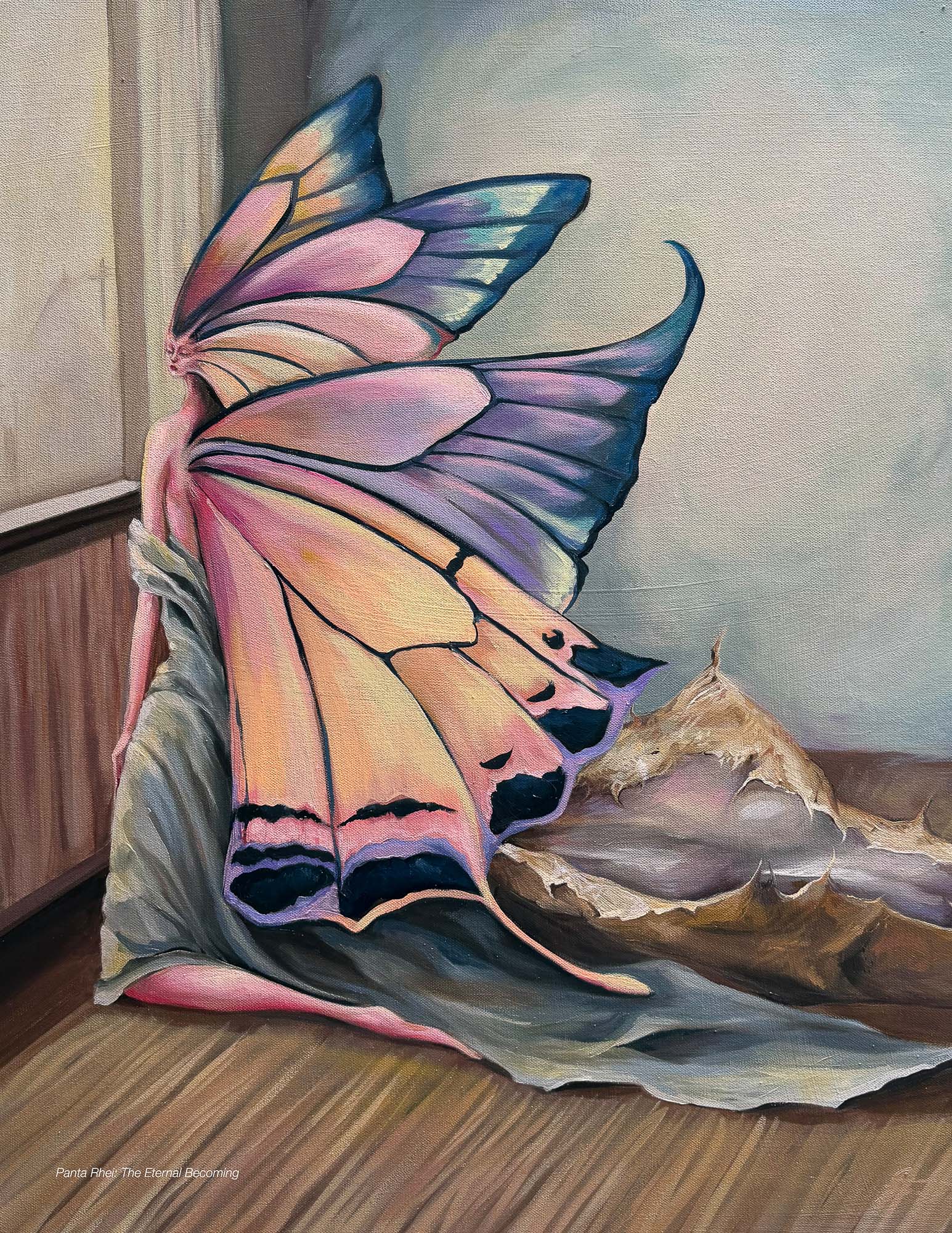
“Panta Rhei: The Eternal Becoming” depicts a butterfly figure emerging from a cocoon. What inspired this work, and what does transformation mean to you personally?
It was born from an idea that has always fascinated me: nothing ever remains exactly as it is. Everything is constantly moving through a process of transformation. The butterfly emerging from its cocoon represents that liminal moment when we are no longer who we were, but have not yet fully become who we are meant to be.
For me, transformation means accepting that identity is not static. We are beings in a constant state of becoming. Sometimes growth requires us to move through darkness, uncertainty, or even rupture before we can recognize our own wings.
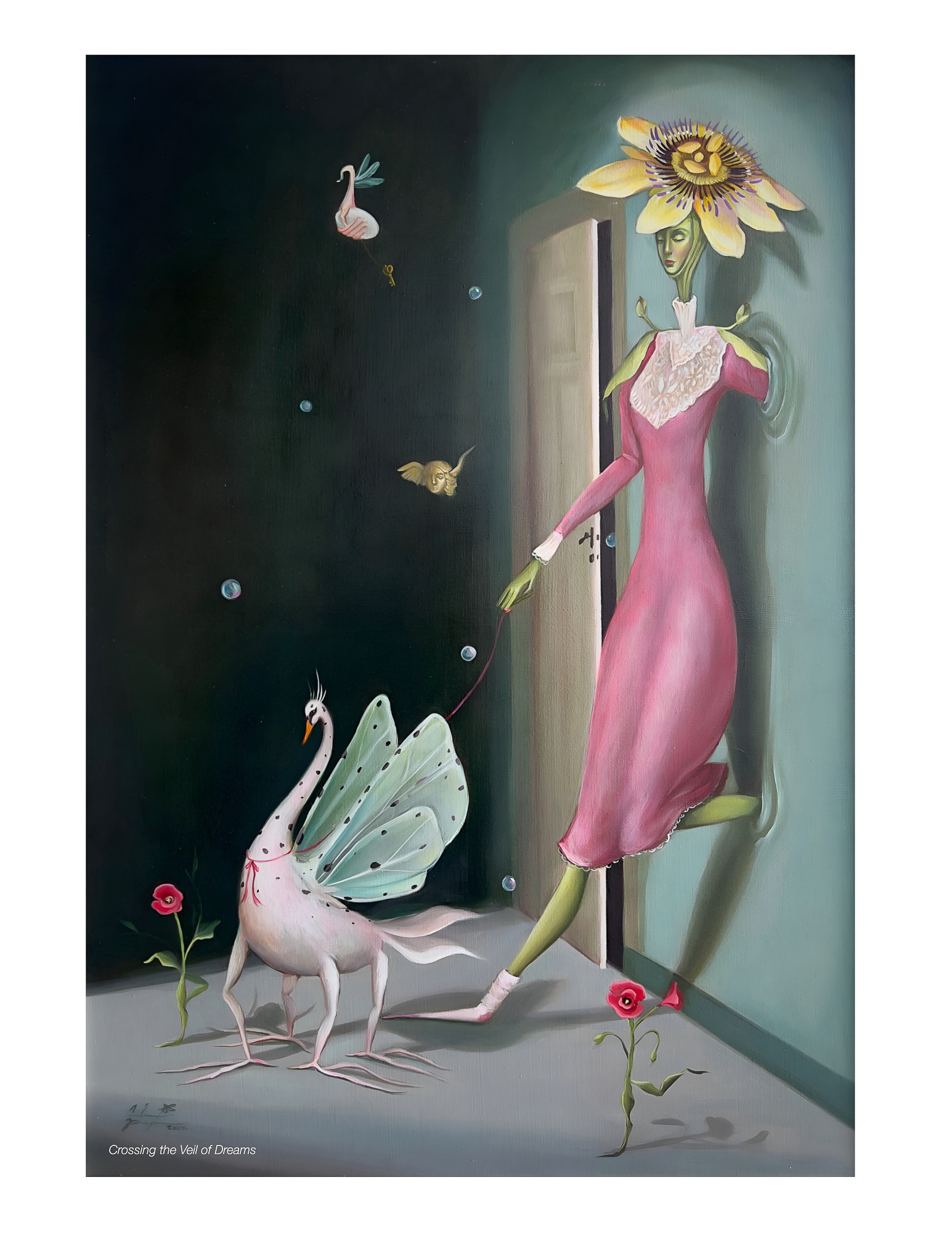
In “Crossing the Veil of Dreams,” a woman follows a swan across the threshold between waking life and the subconscious. How did this journey first take shape?
It emerged from my fascination with that ambiguous territory between waking consciousness and the subconscious. I was intrigued by the idea of a woman who does not simply dream, but chooses to cross into the dream itself.
The swan acts as a kind of guide into this unknown territory. The threshold represents the moment when we leave behind everyday logic and allow other forms of perception to emerge.
For me, entering the dream world is also a way of entering a part of ourselves that remains silent during the day.
What role do your own dreams play in your creative process? Have you painted an image or symbol that came directly from one?
Dreams play a very important role in my creative process. I am fascinated by their logic: the way they bring together seemingly unrelated images, alter scale and perspective, transform identities, and create narratives without obeying the rules of reality.
Sometimes an image appears directly in a dream and stays with me for a long time. Other times, I do not remember the entire dream, but retain a feeling, an atmosphere, or a symbol that later finds its way into my painting.
I think painting has something in common with dreaming while awake. It is a way of allowing certain inner images to find a visible form.
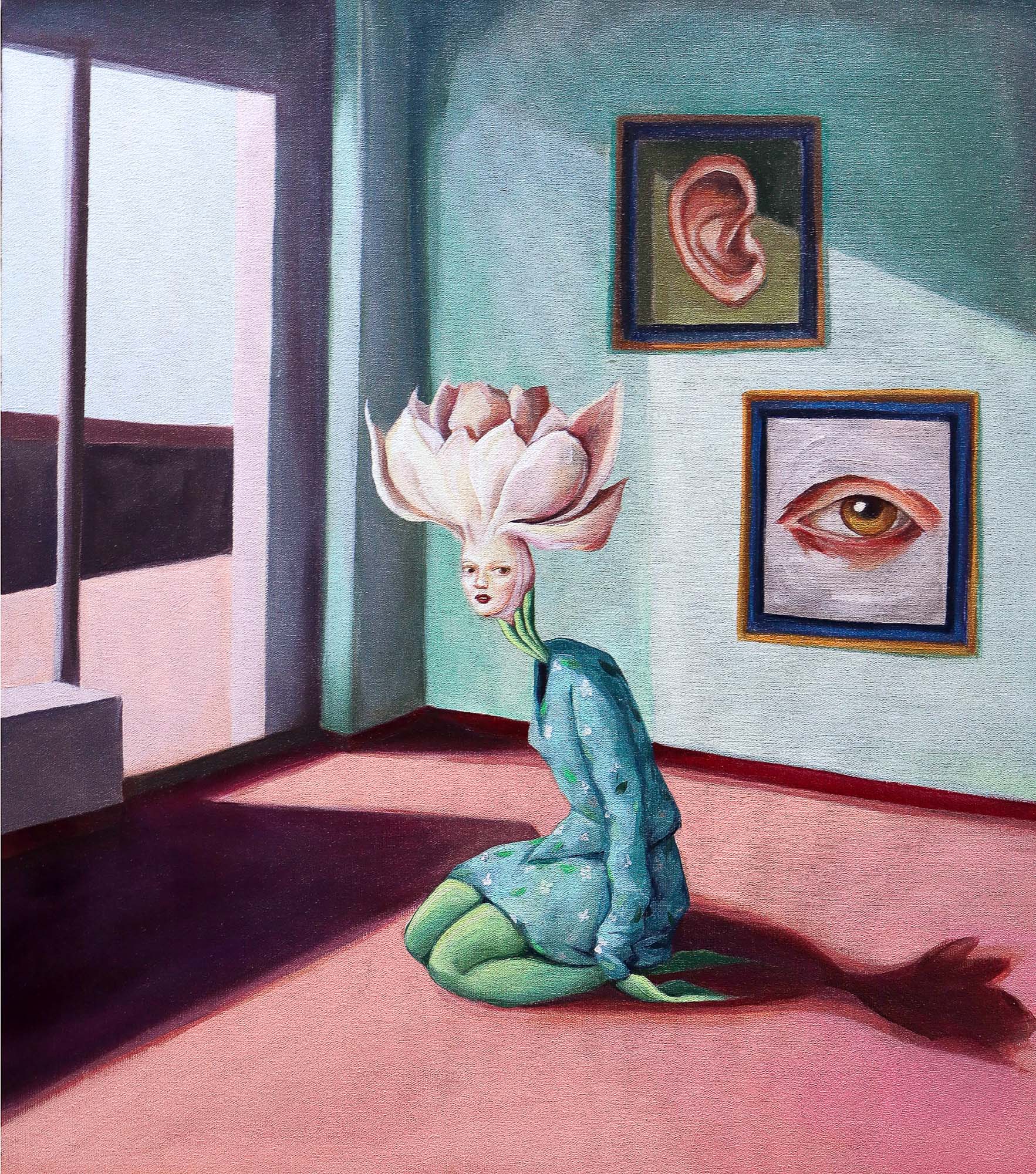
How autobiographical is your work? Do you see the women in your paintings as different versions of yourself, imagined characters, or something in between?
I believe my entire body of work is deeply autobiographical. The women who appear in my paintings can be versions of myself, but they can also be characters born from something collective, from an observed experience, or from a part of myself that I had not yet discovered. They also emerge from questions posed by the outside world.
I do not necessarily see them as literal self-portraits. They exist somewhere between the personal and the imaginary, between what I have lived and what I am still trying to understand.
In that sense, every character becomes a fragment of an identity that is constantly transforming.
What has painting revealed to you about yourself that you might not have discovered otherwise?
Painting has taught me that we often believe we know ourselves until we try to give form to what we feel.
I have discovered that certain parts of ourselves can only emerge when we stop trying to control them. I have also learned that vulnerability is not necessarily a weakness; it can become a source of imagination and strength.
Painting has forced me to look inward, but also outward. It has made me understand that our individual experiences can connect with emotions that are deeply universal.
As your practice continues to evolve, are there new worlds, materials, or forms you want to explore?
I am interested in continuing to expand my universe into sculpture and installation, and in exploring what happens when my characters leave the two-dimensional surface and begin to physically inhabit space.
I also want to experiment with new materials and with ways of creating immersive environments in which the viewer does not simply observe a work, but feels as though they have entered it.
I think the next natural step in my practice is to continue building a bridge between painting and sculpture, between the real and the imagined. I want to create worlds that do not end at the edge of the canvas.
Interview by Indira Cesarine for The Untitled Magazine’s DREAM Issue, available now for purchase – visit untitled-magazine.shop to order your copy.